top of page


CSTO2NE Podcast – Eco-Innovation Business Models. Episode 6: Tomás Navarro Echeverría (Scaphari Ventures)
To close the CSTO2NE podcast series, Episode 6 looks at what happens when innovation becomes a venture: how university spin-offs choose funding, shape business models, and scale—especially in capital-intensive sectors like construction and cleantech. In this episode, Tomás Navarro Echeverría (Scaphari Ventures) shares common business-model weaknesses seen before fundraising and how founders can fix them early. We discuss when bootstrapping makes more sense than venture capita
Mar 311 min read

CSTO2NE Podcast – Eco-Innovation Business Models. Episode 5: Deploying Market-Ready Technologies.
Episode 5 of the CSTO2NE podcast series focuses on the “final mile” of innovation: what it takes to move from market readiness to full-scale deployment and adoption in the construction sector. Our guest, Aloysio Gomes de Souza Filho (Federal University of Technology, Brazil and University of Beira Interior, Portugal), explores why technically proven solutions still face barriers at scale. We discuss lessons from real-world low-carbon and CO₂ mineralisation/CCUS examples (incl
Mar 311 min read


CSTO2NE Podcast – Eco-Innovation Business Models - Episode 4: Piloting Innovation at Scale: Industrial Demonstrations and Certification Roadmaps
In this CSTO2NE podcast series—based on our Training Seminar on Eco-Innovation Business Models (26 January 2026)—we explore what it takes for circular construction innovations to move beyond technical promise toward market adoption. In Episode 4, Lorna Anguilano, Reader and ETC Director at Brunel University London, as well as CTO and Director at Phyona discuss why adoption can still be difficult even when technologies are technically ready. The episode looks at how to positio
Mar 311 min read
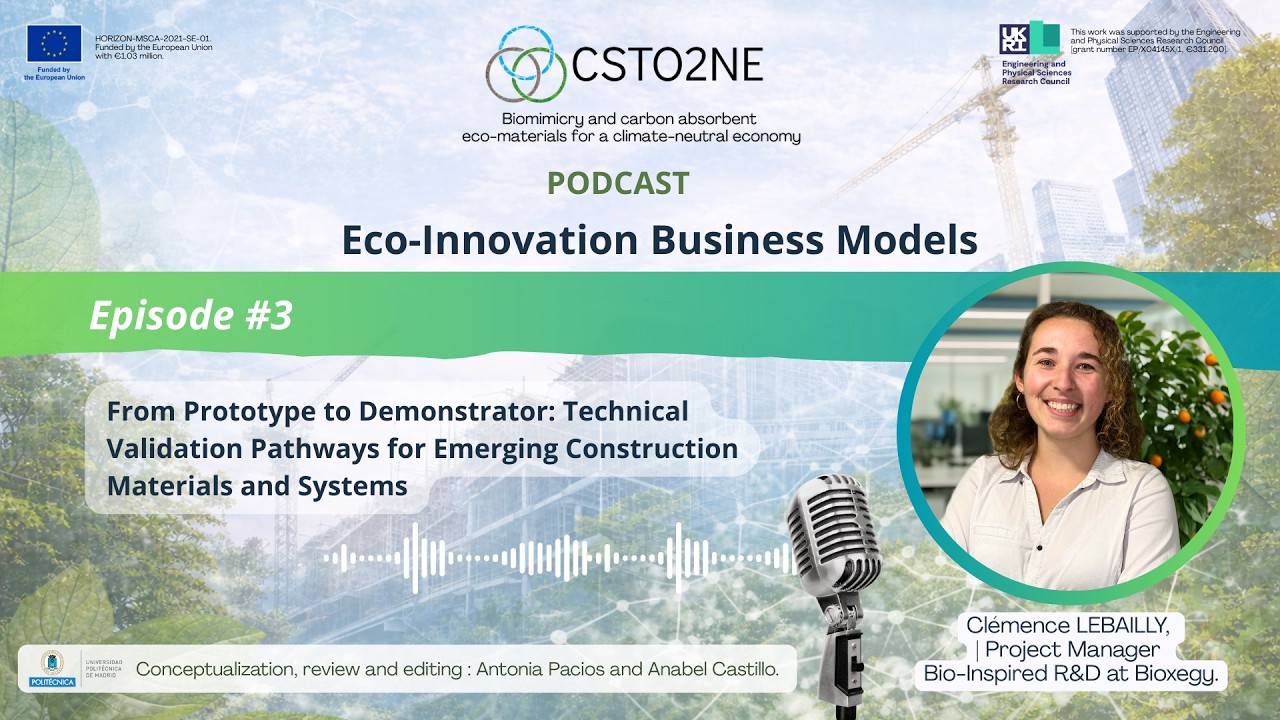
CSTO2NE Podcast – Eco-Innovation Business Models Episode 3: From Prototype to Demonstrator
The CSTO2NE podcast series builds on our Training Seminar on Eco-Innovation Business Models (26 January 2026) and follows the innovation lifecycle—from ecosystem building to scaling. Episode 3 features Clémence Lebailly-Lepetit (Bioxegy) on a critical transition: moving from prototype to demonstrator through credible validation. We discuss how Business Model Canvas can serve as a practical validation tool—not only a business planning exercise—helping teams clarify what must b
Mar 191 min read

CSTO2NE Podcast – Eco-Innovation Business Models Episode 2: Early Incubators in Construction Technologies
As part of the CSTO2NE Training Seminar on Eco-Innovation Business Models (26 January 2026), our podcast series follows the innovation lifecycle and the business-model choices that help circular solutions reach adoption. In Episode 2, João Silva, Head of Innovation at Tecnibuild Group, explains why structured incubation matters—especially in construction, where innovation cannot rely only on individual projects. João shares how an internal incubator helps organisations screen
Mar 191 min read
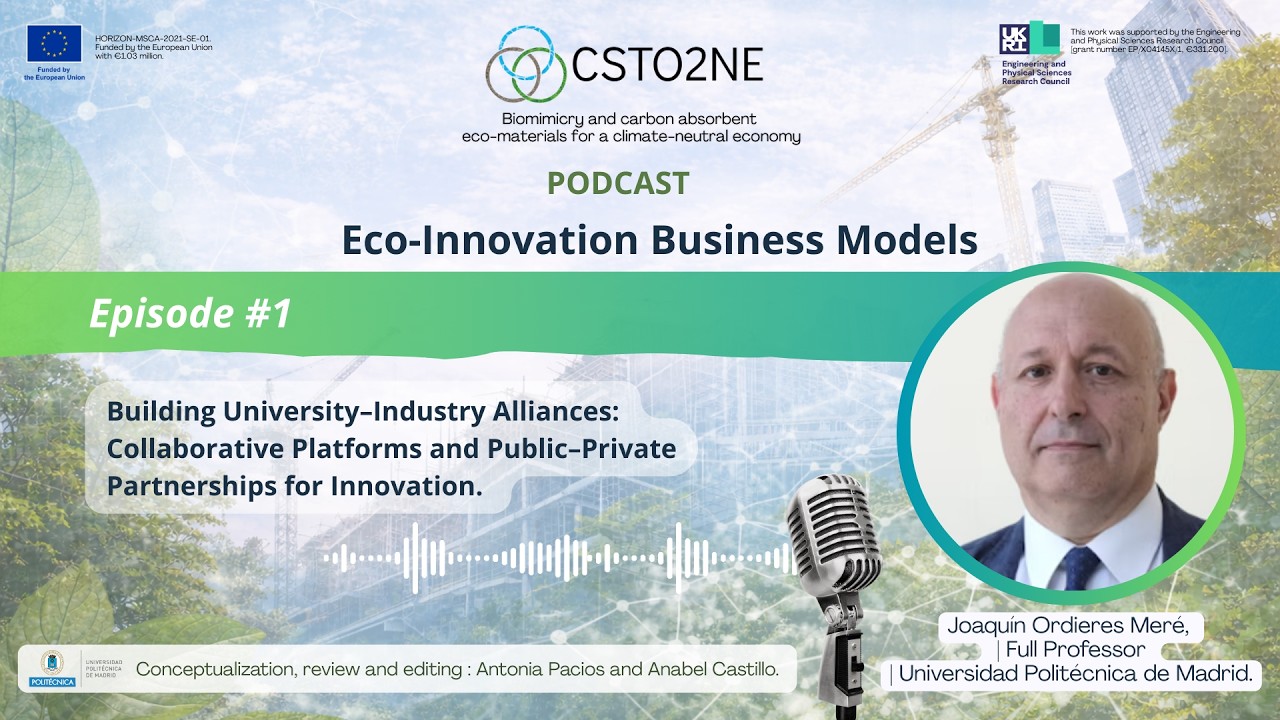
CSTO2NE Podcast – Eco-Innovation Business Models Episode 1: Building University–Industry Alliances for Innovation
Following our CSTO2NE Training Seminar on Eco-Innovation Business Models (26 January 2026, hybrid, coordinated by UPM), we are releasing a six-episode podcast series exploring how circular construction innovations move from early ideas to real world impact. In Episode 1, Joaquín Ordieres Meré (UPM) focuses on the innovation ecosystem itself: why collaboration models based on ecosystems often outperform linear “technology transfer”, how roles should be distributed across univ
Mar 191 min read
bottom of page